Same-Sex Genetic Reproduction
Key points
- Mouse studies have shown partial proof-of-concept under highly engineered conditions, especially by manipulating imprinting and chromosome states.
- Human research remains at the stage of early germline models, epigenetic reprogramming models, and proof-of-concept engineering, not developmentally validated human gametes.
- Major barriers include imprinting, meiosis, chromosome biology, oocyte cytoplasmic competence, placental development, and long-term safety.
- Engineering tools may bypass or compensate for some barriers, but each bypass creates new validation burdens.
A research question at the intersection of IVG, epigenetics, chromosomes, and engineering
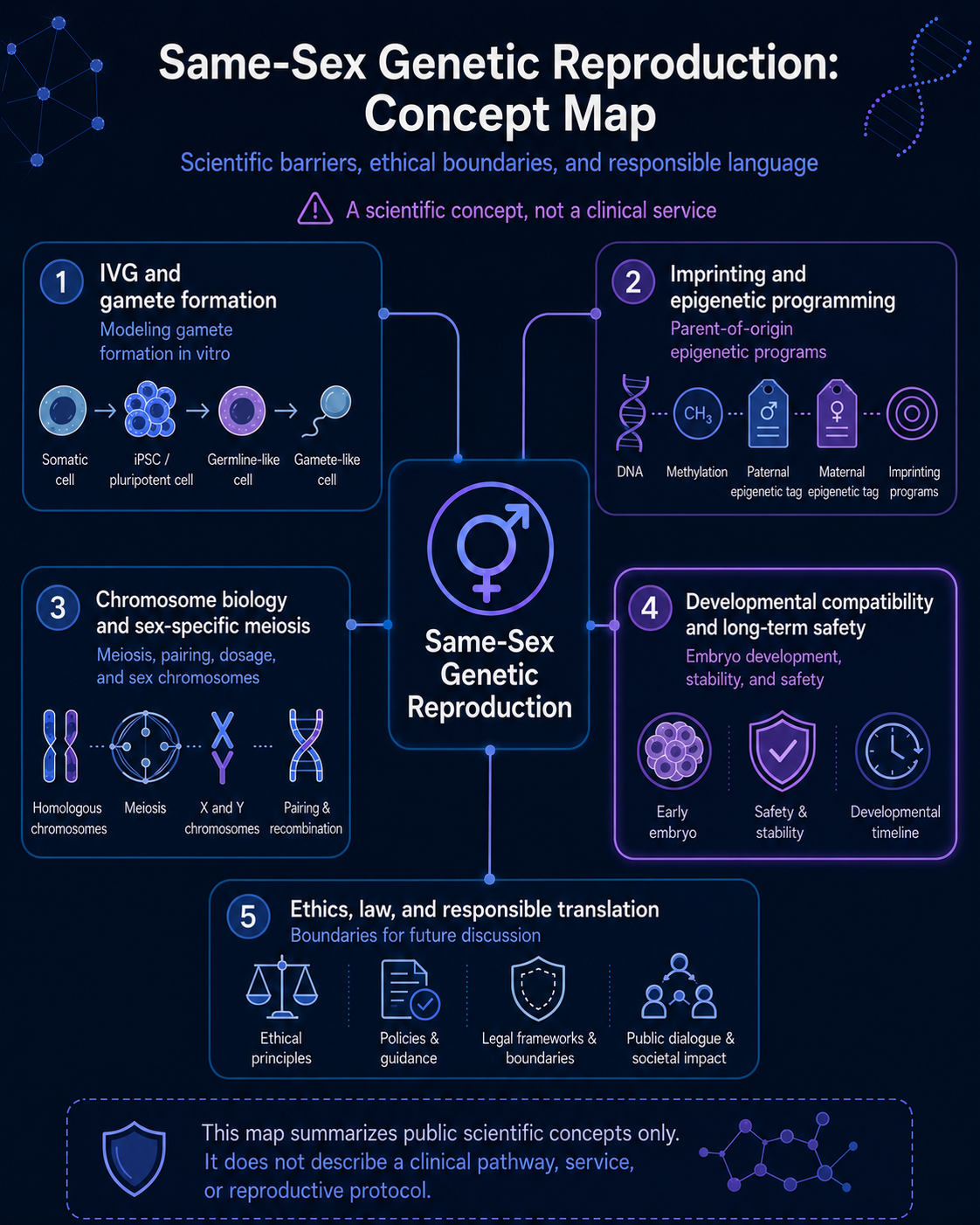
Same-sex genetic reproduction asks whether two individuals of the same sex could both contribute nuclear genomes to a future offspring. In mammals, this is not simply a question of combining two sets of DNA. A developmentally competent embryo normally depends on a coordinated system of maternal and paternal contributions: parent-of-origin epigenetic programs, sex-specific gametogenesis, correct meiosis, chromosome dosage, oocyte cytoplasmic factors, early embryonic reprogramming, placental development, and long-term developmental stability.
Public research has already shown that some of these barriers can be manipulated in mice under highly engineered conditions. Bimaternal, bipaternal, androgenetic, and parthenogenetic mouse models have demonstrated that genomic imprinting is one of the central causal barriers to mammalian unisexual reproduction. At the same time, these studies also show why the problem is not solved by editing a few loci or combining two genomes. Successful mouse experiments often depend on imprinting-region deletion or rewriting, chromosome-state correction, oocyte cytoplasmic support, embryo transfer systems, and strong selection. [1–5], [14], [15]
For humans, the evidence is at a much earlier stage. Human studies have produced hPGCLC, oogonia-like, and pro-spermatogonia-like states, and recent work has reconstructed parts of human germline epigenetic reprogramming in vitro. However, these models have not produced human gametes that are proven to be developmentally competent, genetically stable, epigenetically appropriate, and safe for reproduction. [10–13]
A useful way to read this field is to distinguish scientific thinking from engineering thinking. Scientific thinking asks why mammals normally require differently programmed maternal and paternal genomes. Engineering thinking asks which barriers might be corrected, compensated for, bypassed, or screened out. The important lesson is that engineering can sometimes move a system past one barrier, but each bypass creates a new validation burden. [17–20]
IVG and gamete formation
In vitro gametogenesis is relevant to same-sex genetic reproduction because it studies whether gamete-like cells can be generated from earlier cell states, such as pluripotent stem cells or reprogrammed somatic cells. In mouse systems, IVG has reached major functional milestones. Mouse pluripotent stem cells have been differentiated into primordial germ cell-like cells, further developed into oocytes, and used to generate offspring. Other mouse studies have reconstructed male germ-cell development and produced functional sperm or sperm-like cells in vitro. [6–9]
These achievements explain why IVG is central to future reproductive science. They also show why the word “gamete-like” must be used carefully. A germline-like cell may resemble early germ cells in gene expression or epigenetic state. A gamete-like cell may resemble a later oocyte-like or sperm-like state. But a developmentally competent gamete must do much more: complete appropriate meiosis, acquire the correct haploid genome, establish or maintain the right epigenetic state, mature cytoplasmically, support fertilization, and sustain development beyond early embryos.
The distinction between female-female and male-male genetic reproduction is also biologically important. A female-female route would require either a paternal-like epigenetic contribution or a sperm-functional route from female-derived cells. A male-male route has additional barriers: it would require oocyte-like development, an oocyte cytoplasmic environment, maternal factors, mitochondrial considerations, and often an engineered sex-chromosome state compatible with oogenesis. Mouse work on male-derived oocytes illustrates this point: male mouse cells did not simply become oocytes; they first underwent chromosome-state engineering toward a euploid XX pluripotent state before entering an oogenic pathway. [12]
The unresolved questions are therefore precise. Which human cell states are truly competent for later germline induction? Can human hPGCLC-like cells progress into later oogonial or pro-spermatogonial states with correct epigenetic reprogramming? What features distinguish a gamete-like cell from a developmentally competent gamete? And can these features be validated without relying only on marker expression or early embryo morphology? [10–13]
Imprinting and epigenetic programming
Genomic imprinting is one of the central biological barriers in mammalian same-sex genetic reproduction. Maternal and paternal genomes are not interchangeable copies of the same DNA. During gametogenesis, they acquire parent-of-origin epigenetic programs. These programs regulate imprinted gene clusters through imprinting control regions, germline differentially methylated regions, secondary DMRs, chromatin structure, allele-specific expression, and in some cases long non-coding RNA-mediated regulation.
Mouse studies have repeatedly shown that imprinting defects are not merely associated with unisexual reproductive failure; they can be causal. Bimaternal mouse models have used imprinting-region deletions to overcome specific maternal-maternal incompatibilities. Bipaternal mouse models have required deeper engineering, including multiple imprinting-related deletions or regulatory edits. More recent work using targeted epigenetic editing of imprinting control regions suggests that rewriting DNA methylation at selected ICRs may, in some mouse contexts, support development that would otherwise fail. [1–5], [14], [15]
This is strong evidence that imprinting can be engineered in animals. It is not evidence that human imprinting can be treated as a small checklist. Human and mouse imprinting systems share broad principles but differ in specific loci, tissue specificity, placental regulation, and non-classical imprinting patterns. Placental development is especially important, because many imprinted genes influence extraembryonic growth, nutrient transfer, and fetal growth trajectories.
For this reason, epigenetic safety cannot be evaluated only by checking a few classic DMRs. A more serious framework would require allele-specific methylation, imprinted cluster expression, chromatin state, persistence through early embryonic reprogramming, and separate analysis of embryonic and placental lineages. A normal-looking early embryo is not enough to prove that parent-of-origin programming has been reconstructed safely. [13], [17–20]
Chromosome biology and sex-specific meiosis
Same-sex genetic reproduction is also a chromosome biology problem. A reproductive genome is not just a diploid DNA mixture. It normally passes through meiosis, homologous chromosome pairing, recombination, segregation, and haploidization before fertilization restores diploidy.
Sex chromosomes add another layer. Oogenesis and spermatogenesis do not use identical chromosome environments. XX, XY, XO, or engineered sex-chromosome states can influence whether a cell can enter and complete a sex-appropriate germline pathway. In mouse work where male-derived cells were used to generate oocytes, the cells first had to acquire a euploid XX state. This suggests that chromosome-state normalization may be a gateway into an oogenic program, but it does not itself prove complete oocyte competence. [12]
The same logic applies to any attempt to bypass meiosis. Nuclear transfer or mitomeiosis-like approaches may attempt to reduce chromosome ploidy without fully reconstructing natural gametogenesis. Such work is scientifically important because it reveals manipulable biological windows. But if homologous chromosome segregation is random or aneuploidy remains high, the result is not a validated gamete substitute. [16]
Key unresolved questions include whether engineered sex-chromosome states can support correct homologous pairing and recombination, whether X-chromosome reactivation and dosage are properly regulated, whether Y-linked germline factors can be replaced or bypassed, and whether chromosome normality, transcriptomic similarity, and epigenetic similarity are actually predictive of developmental competence.
Developmental compatibility and long-term safety
Early embryo development is not a sufficient endpoint for safety. A system that reaches cleavage or blastocyst-like stages may still fail during implantation, placental development, fetal growth, birth, postnatal health, fertility, or intergenerational transmission.
Mouse bipaternal studies illustrate this problem clearly. Some engineered bipaternal embryos have reached live birth, but early versions died soon after birth. Later studies pushed development further, even to adulthood in some cases, but still reported low efficiency, postnatal mortality, developmental abnormalities, shortened lifespan, or infertility. This does not make the experiments unimportant. It means that the relevant endpoint has shifted from “Can development begin?” to “Can development remain stable across the whole life course?” [4], [14], [15]
Placental development deserves special emphasis. Many imprinted genes are active in extraembryonic tissues, and placental abnormalities may reveal epigenetic errors that are not obvious from early embryo morphology. For any system involving imprinting correction, non-natural gamete formation, chromosome engineering, or nuclear transfer, the placenta is not a side issue. It is one of the most informative safety readouts.
A more complete safety framework would include preimplantation development, implantation, placental histology and molecular state, fetal growth, live birth rate, postnatal growth, metabolism, behavior, fertility, and intergenerational epigenetic stability. Without these endpoints, early developmental success should be interpreted as upstream proof-of-concept, not as evidence of reproductive readiness. [17–20]
Ethics, law, and responsible translation
Ethical and legal questions arise because same-sex genetic reproduction would involve germline cells, embryos, future children, and possibly heritable genome or epigenome changes. These questions are not separate from the biology. They become important because mistakes in gamete formation, imprinting, chromosomes, or early development could affect a future child rather than only a laboratory cell. [17–20]
The main ethical issue is not whether same-sex families are valid. The more specific issue is how any future reproductive technology should protect the health and rights of the child who may be born from it. If the biological risks are uncertain, the future child is the person who would carry those risks.
Consent is another central issue. If ordinary body cells could one day be reprogrammed into gamete-like cells, then a cell sample would no longer be just a research sample. It could have reproductive significance. Clear rules would be needed to define who can authorize reproductive use, how consent should be given, and how to prevent gamete creation from someone’s cells without their permission.
Law would also need to address parenthood, donor status, genetic contribution, and responsibility. If cells, engineered gametes, edited embryos, or donor oocyte cytoplasm were involved, it may not always be obvious how legal parenthood and biological contribution should be defined.
Responsible translation would require more than technical progress. It would require strong evidence, independent review, long-term animal data, clear safety endpoints, public discussion, and regulatory oversight. This is especially important because the topic could be vulnerable to commercial overstatement, medical tourism, and gray-market claims.
For this reason, governance should be treated as part of the research landscape. The central question is not only whether a biological system can be engineered, but whether the evidence is strong enough, the risks are measurable enough, and the rules are clear enough to justify moving from research models toward any reproductive use.
Engineering lens
Engineering approaches: what biotechnology might attempt
The engineering perspective is valuable because it does not treat every biological barrier as an all-or-nothing mystery. It asks which barriers can be modularly corrected, compensated for, bypassed, or filtered out.
One engineering route is imprinting correction. This includes imprinting-region deletion, regulatory-region editing, frameshift mutation, gene deletion, ICR manipulation, and targeted epigenetic rewriting. In mouse models, these strategies can remove or compensate for specific parent-of-origin conflicts. Their risk is that local correction may disrupt broader regulatory domains, neighboring genes, placental expression, or long-term imprint stability. [1–5], [14], [15]
A second route is epigenome editing. Tools such as dCas9-DNMT or dCas9-TET systems, in principle, could add or remove methylation without changing the DNA sequence. This is conceptually attractive for imprinting, because imprinting is often a problem of allele-specific epigenetic state rather than coding sequence. However, epigenome editing faces hard questions: Can it be allele-specific? Is the edited state stable? Does it persist through embryonic reprogramming? Does it affect nearby chromatin or distant regulatory networks? [15]
A third route is chromosome-state engineering. Mouse work suggests that changing sex-chromosome state can redirect developmental potential under some conditions. But a normal-looking karyotype is not the same as correct meiosis, correct imprinting, or a competent gamete. Chromosome engineering may open a door, but it does not validate the whole pathway. [12]
A fourth route is IVG platform engineering. Support cells, gonadal somatic cells, co-culture systems, organoid-like models, reconstructed ovarian or testicular environments, and single-cell multiomics feedback may help make in vitro germline development more robust. The limitation is that developmental similarity does not automatically equal functional competence. [6–13]
A fifth route is nuclear transfer or mitomeiosis-like engineering. These strategies try to bypass parts of natural gametogenesis by using oocyte cytoplasm and experimentally induced chromosome reduction. Their appeal is engineering efficiency. Their central risk is chromosome mis-segregation, aneuploidy, mitochondrial and cytoplasmic dependence, and incomplete reprogramming. [16]
Finally, screening and quality control can reduce some known risks. Whole-genome sequencing, karyotyping, single-cell transcriptomics, methylome profiling, allele-specific imprinting analysis, and developmental assays can identify abnormal products. But screening cannot prove unknown risks are absent. It can only test what the field knows how to measure. [17–20]
Gene editing: possible tool, not universal solution
Gene editing may become an important research tool in this field. It can test causality, modify imprinting-related regions, alter regulatory elements, or help construct animal models. But gene editing is not a universal solution to same-sex genetic reproduction. [17–20]
CRISPR-Cas9 can introduce off-target changes, on-target large deletions, complex rearrangements, structural variants, and mosaic outcomes. Base editing and prime editing may reduce some double-strand-break-associated risks, but they still face efficiency limits, bystander edits, delivery constraints, editing-window constraints, and product-purity questions. Epigenome editing avoids sequence change in principle, but introduces its own uncertainties: stability, allele specificity, developmental persistence, and unintended chromatin effects. [15]
The hardest problem is that reproductive applications would involve heritable genome or epigenome modification if edited gametes, embryos, or germline precursors contributed to offspring. This shifts the issue from cell engineering to intergenerational risk. The future child cannot consent, errors may propagate, and long-term consequences may not be visible in early development. [17–20]
For public communication, the most accurate framing is that gene editing can help investigate or engineer specific barriers in research models. It cannot by itself prove that a system is developmentally safe, ethically acceptable, or ready for human reproductive use. [17–20]
Open research questions
- Which molecular and cellular features predict developmental competence rather than merely germline-like identity?
- Can human hPGCLC-derived cells progress into later germline states with correct meiosis, epigenetic reprogramming, and maturation?
- Which imprinting control regions are necessary and sufficient barriers in mouse unisexual reproduction, and are their human regulatory functions conserved?
- Can allele-specific methylation states be reconstructed and maintained through early embryonic reprogramming and placental development?
- Can engineered XX, XY, or XO states undergo sex-appropriate meiosis with correct homologous pairing, recombination, and segregation?
- Can mitomeiosis-like strategies move from random chromosome reduction to controlled, validated haploidization?
- Which placental readouts predict later fetal, postnatal, and intergenerational outcomes?
- Which quality-control assays are predictive of safety, rather than merely descriptive of similarity?
- What level of long-term animal evidence would be required before human relevance could be responsibly discussed?
- How should gene editing, epigenome editing, and IVG be governed when research tools begin to resemble potential reproductive interventions?
Core references
- Kono et al. Nature, 2004. “Birth of parthenogenetic mice that can develop to adulthood.”
- Kawahara et al. Nature Biotechnology, 2007. “High-frequency generation of viable mice from engineered bi-maternal embryos.”
- Li et al. Cell Research, 2015. “Birth of Fertile Bimaternal Offspring Following Intracytoplasmic Injection of Parthenogenetic Haploid Embryonic Stem Cells.”
- Li et al. Cell Stem Cell, 2018. “Generation of Bimaternal and Bipaternal Mice from Hypomethylated Haploid ESCs with Imprinting Region Deletions.”
- Deng et al. Biology of Reproduction, 2011. “Generation of Viable Male and Female Mice from Two Fathers.”
- Hayashi et al. Science, 2012. “Offspring from oocytes derived from in vitro primordial germ cell-like cells in mice.”
- Ishikura et al. Cell Reports, 2016. “In Vitro Derivation and Propagation of Spermatogonial Stem Cell Activity from Mouse Pluripotent Stem Cells.”
- Ishikura et al. Cell Stem Cell, 2021. “In vitro reconstitution of the whole male germ-cell development from mouse pluripotent stem cells.”
- Sato et al. Nature, 2011. “In vitro production of functional sperm in cultured neonatal mouse testes.”
- Yamashiro et al. Science, 2018. “Generation of human oogonia from induced pluripotent stem cells in vitro.”
- Hwang et al. Nature Communications, 2020. “Reconstitution of prospermatogonial specification in vitro from human induced pluripotent stem cells.”
- Murakami et al. Nature, 2023. “Generation of functional oocytes from male mice in vitro.”
- Murase et al. Nature, 2024. “In vitro reconstitution of epigenetic reprogramming in the human germ line.”
- Li et al. Cell Stem Cell, 2025. “Adult bi-paternal offspring generated through direct modification of imprinted genes in mammals.”
- Wei et al. PNAS, 2025. “Fertile androgenetic mice generated by targeted epigenetic editing of imprinting control regions.”
- Gutierrez et al. Nature Communications, 2025. “Induction of experimental cell division to generate cells with reduced chromosome ploidy.”
- WHO, 2021. Human genome editing: recommendations.
- ISSCR Guidelines for Stem Cell Research and Clinical Translation, 2021/2025.
- National Academies / Royal Society / National Academy of Medicine, 2020. Heritable Human Genome Editing.
- National Academies, 2023. In Vitro–Derived Human Gametes as a Reproductive Technology: Scientific, Ethical, and Regulatory Implications.