Safety and Competence
How IVG models are evaluated beyond similarity
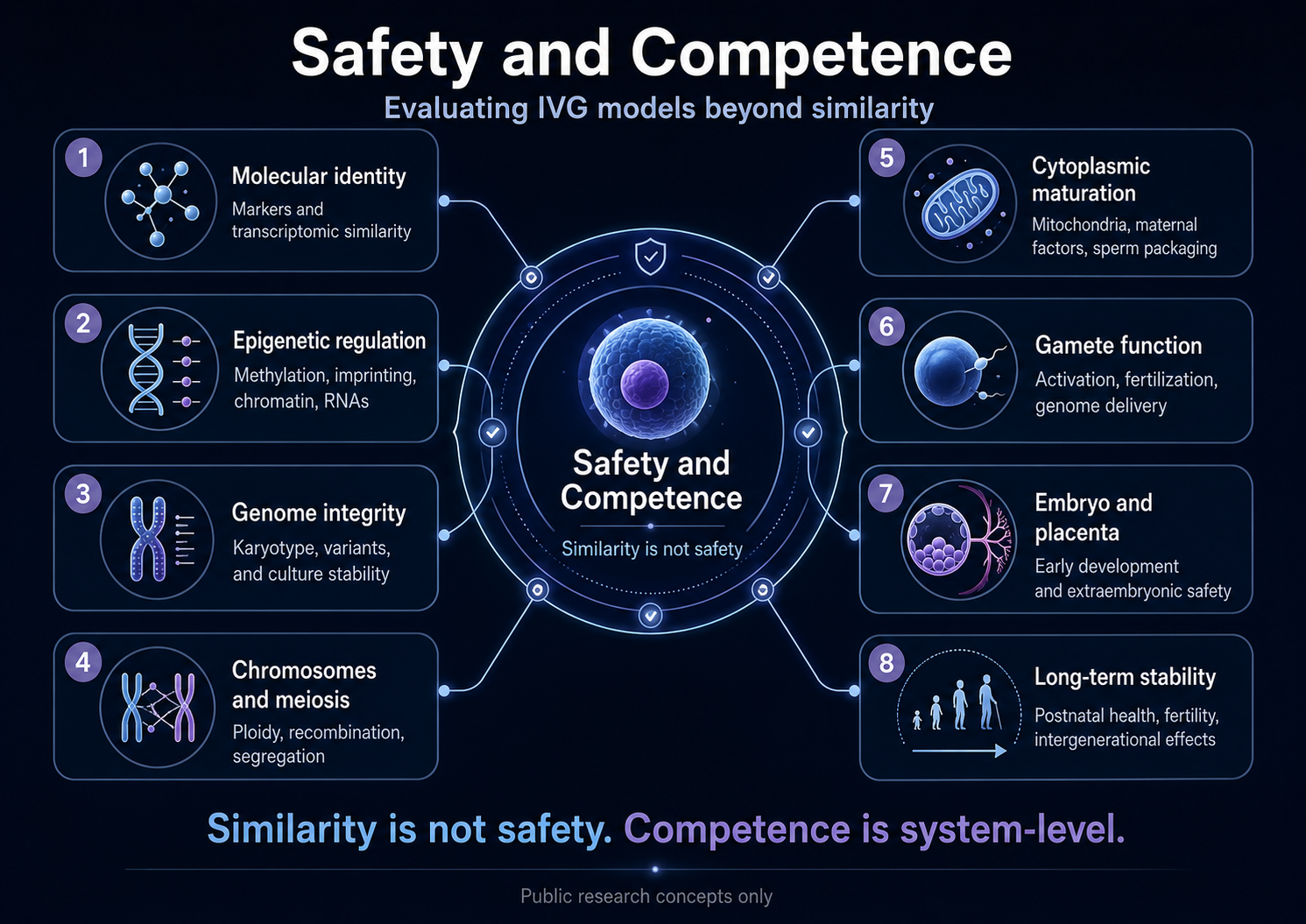
IVG research often uses the language of similarity: germline-like cells, oocyte-like cells, sperm-like cells, transcriptomic similarity, epigenetic similarity, and developmental resemblance. These comparisons are useful, but they are not the same as safety.
A cell may express germline markers, cluster near fetal germ cells in single-cell analysis, or show partial epigenetic reprogramming. That does not prove that it has completed correct meiosis, acquired the right chromosome state, established appropriate imprinting, matured cytoplasmically, supported embryo and placental development, or remained stable across long-term and intergenerational outcomes.
This page uses the broader term “safety and competence” rather than focusing only on epigenetic safety. Epigenetics remains central, especially DNA methylation, imprinting, chromatin state, small RNAs, and X-chromosome regulation. But artificial gamete competence is a system-level question. It involves molecular identity, genome integrity, chromosome biology, meiosis, cytoplasmic maturation, embryo development, placenta, long-term health, reproducibility, and governance.
The goal is not to define a clinical testing workflow. The goal is to explain why IVG-derived or artificial gamete-like cells require multi-layer evaluation before any strong claim about developmental competence can be made. [1–24]
Key points
- Similarity is not safety. Marker expression, transcriptomic similarity, and epigenetic similarity are evidence levels, not final proof of functional gametes. [10–19]
- Epigenetic safety is multi-layered. DNA methylation is important, but imprinting, histone states, chromatin accessibility, 3D genome organization, small RNAs, transposon control, RNA regulation, and X-chromosome state also matter. [15–19]
- Gamete competence goes beyond epigenetics. Genome integrity, chromosome number, sex chromosomes, meiosis, cytoplasmic maturation, mitochondrial function, and gamete-specific functions must also be considered. [3–15]
- Embryo development is not the final endpoint. Early cleavage or blastocyst-like development cannot by itself prove implantation, placental development, postnatal health, fertility, or intergenerational stability. [20–24]
- Human evidence is more limited than mouse evidence. Mouse IVG provides foundational functional evidence, but human IVG remains largely at the level of early germline models, later germline-like states, and epigenetic reprogramming models. [3–15]
- Public communication should avoid evidence jumps. “Germline-like,” “gamete-like,” and “developmentally competent gamete” should not be used as interchangeable terms. [20–24]
Why similarity is not safetyScientific models often begin with resemblance, but resemblance does not prove that an artificial gamete-like cell is safe or developmentally competent.
Researchers may ask whether a cell expresses germline markers, whether its RNA profile resembles fetal germ cells, whether its methylation pattern moves in the expected direction, or whether it forms a structure that looks like an oocyte-like or sperm-like state.
These comparisons are valuable, but they answer limited questions. A marker can identify cell fate direction. A single-cell map can locate a cell near a reference state. A methylation profile can show partial epigenetic reprogramming. A morphology can suggest maturation. None of these, alone, proves that the cell can function as a safe and competent gamete.
A stronger framework asks what each evidence level can and cannot support. Marker expression supports identity, not function. Transcriptomic similarity supports resemblance, not developmental competence. Epigenetic similarity supports progress in reprogramming, not complete safety. Meiotic markers support meiotic entry, not necessarily correct chromosome segregation. Gamete-like morphology supports advanced differentiation, not necessarily fertilization capacity or healthy development.
For this reason, this page treats safety and competence as a layered evidence problem. The central question is not whether a cell looks like a gamete. The question is whether it has the molecular, chromosomal, meiotic, cytoplasmic, developmental, and long-term properties needed for a competent reproductive cell. [10–24]
Molecular and epigenetic layersEpigenetic safety is not only DNA methylation. It also includes imprinting, histone states, chromatin accessibility, 3D genome organization, small RNAs, transposon control, RNA regulation, and X-chromosome state.
Epigenetic safety is often reduced to DNA methylation, but that is too narrow. DNA methylation is central because germline development involves large-scale methylation erasure, stage-specific rebuilding, and sex-specific epigenetic programming. However, global methylation averages can miss local, allele-specific, or developmentally timed errors.
Genomic imprinting is especially important. Imprinting involves parent-of-origin regulation, germline DMRs, imprinting control regions, secondary DMRs, allele-specific methylation, allele-specific expression, long non-coding RNA regulation, chromatin-domain control, and placental effects. In same-sex genetic reproduction, imprinting is not a side issue; it is one of the central biological barriers.
Histone modifications add another layer. Active and repressive histone marks, such as H3K4me3, H3K27me3, H3K9me3, and H3K27ac, help define whether genes and regulatory regions are poised, active, or silenced. Some developmental and imprinting-related regulatory states cannot be understood from DNA methylation alone.
Chromatin accessibility and regulatory-element activity also matter. A cell may have a similar transcriptome but still lack the correct enhancer activity, promoter accessibility, or germline-specific regulatory architecture. Open chromatin helps reveal whether a cell is following the correct developmental program or only approximating its endpoint expression profile.
The 3D genome and nuclear organization are often under-discussed. TADs, enhancer-promoter contacts, lamina association, imprinting-domain looping, X-chromosome architecture, and meiotic chromosome organization may affect whether gene regulation is correctly coordinated in space.
Small RNAs, piRNA pathways, and transposon control are also relevant. Germline reprogramming can expose the genome to transposon risk. If repeat elements are not properly controlled, artificial gamete-like cells may appear molecularly similar while carrying hidden instability.
RNA regulation and RNA modifications are especially important for oocyte competence. Maternal RNA storage, RNA decay, translational control, m6A regulation, and the oocyte-to-embryo transition cannot be fully inferred from DNA methylation or marker expression. In sperm, small RNAs and chromatin packaging may also influence early developmental outcomes.
X-chromosome state and dosage compensation sit between epigenetics and chromosome biology. X inactivation, X reactivation, X dosage, X-chromosome architecture, and sex-chromosome state are especially important in human pluripotent cells, germline models, and same-sex reproduction-related questions. X reactivation alone is not proof of correct germline development. [10–19]
Beyond epigenetics: what else must be evaluated?Artificial gamete competence cannot be judged by epigenetics alone. It also requires cell identity, developmental stage matching, genome integrity, chromosome state, meiosis, cytoplasmic maturation, gamete function, and platform reproducibility.
First, cell identity must be evaluated. Markers, immunostaining, flow cytometry, qPCR, scRNA-seq, and trajectory mapping can show whether a cell resembles a germline state. But identity does not prove function.
Second, developmental stage matching matters. A cell should be compared with the appropriate reference: PGCLC, fetal PGC, oogonia, prospermatogonia, spermatocyte, oocyte, spermatid, sperm, or early embryo. The comparison should be stage-matched, sex-matched, and tissue-context-aware.
Third, genome integrity must be checked. Karyotype, copy-number variation, structural variants, SNVs, indels, culture-acquired abnormalities, and clonal selection can all affect safety independently of epigenetic state.
Fourth, chromosome number, sex chromosomes, and ploidy must be correct. Haploidization, aneuploidy, euploidy, X/Y state, and sex-chromosome compatibility are not optional details. They are central to gamete biology.
Fifth, meiosis must be evaluated carefully. Entry into meiosis is not the same as correct meiosis. Synapsis, homologous recombination, crossover formation, chromosome segregation, and accurate haploidization all matter.
Sixth, cytoplasmic maturation is essential. For oocyte-like cells, this includes mitochondria, mtDNA copy number, ATP metabolism, cortical granules, maternal RNA and protein stores, spindle quality, organelle distribution, and oocyte cytoplasmic competence. For sperm-like cells, this includes acrosome formation, flagellum, motility, protamination, DNA compaction, DNA fragmentation, and paternal genome delivery.
Seventh, direct gamete function matters. Oocyte-like cells may need to support activation, fertilization, pronuclear formation, and early embryo development. Sperm-like cells may need motility, capacitation, acrosome reaction, zona interaction, and paternal genome delivery. In human systems, many of these functional tests face ethical and legal limits, which is one reason human IVG safety cannot be validated in the same way as mouse IVG.
Finally, reproducibility matters. A single successful differentiation result does not validate a platform. Batch-to-batch variation, cell-line variation, clone-specific abnormalities, culture adaptation, and selection bias all affect whether a system is robust. [3–24]
Developmental readouts: embryo, placenta, and long-term outcomesEarly embryo development is stronger evidence than marker expression, but it is still not the final endpoint. Placenta, postnatal health, fertility, and intergenerational stability remain separate questions.
Early embryo development is a stronger endpoint than marker expression or transcriptomic similarity, but it is still not the final endpoint. Cleavage or blastocyst-like development may show that some early developmental events can begin, but it does not prove implantation, placental development, fetal growth, birth, postnatal health, fertility, or intergenerational stability.
The placenta deserves special attention. Many imprinting defects and epigenetic abnormalities affect extraembryonic development, fetal growth, nutrient exchange, and placental function. A gamete-like cell could appear acceptable at the level of early embryo morphology while still carrying errors that become visible later in placental or fetal development.
In animal models, stronger evidence includes live birth, survival, growth, metabolism, behavior, fertility, lifespan, second-generation outcomes, and intergenerational epigenetic stability. These endpoints provide high-value evidence, but they still cannot be automatically transferred to humans because human germline development, imprinting, placentation, meiosis, and embryo research constraints differ from mouse systems.
For public communication, the safest framing is this: early development can support proof-of-concept, but long-term and intergenerational safety require stronger evidence. [20–24]
Evidence ladder for artificial gamete evaluationEvidence should be read as a ladder. Lower levels support identity or similarity; higher levels support function, development, and long-term stability.
- Marker expression — shows partial identity, not function.
- Transcriptomic similarity — shows resemblance to a reference state, not developmental competence.
- Epigenetic similarity — shows progress in reprogramming, not complete epigenetic safety.
- Chromatin and regulatory-state similarity — shows whether regulatory elements and chromatin states are approaching the expected developmental program, but does not prove function.
- Meiotic progression — shows meiotic entry or partial meiotic events, not necessarily correct chromosome segregation.
- Gamete maturation — shows a more advanced gamete-like state, not necessarily fertilization capacity or healthy development.
- Gamete function — shows direct functional potential, but may still miss later developmental and long-term risks.
- Embryo development — shows early developmental support, not necessarily placental or postnatal safety.
- Offspring in animal models — stronger evidence of developmental output, but not automatically transferable to humans.
- Long-term and intergenerational stability — the strongest animal-level evidence, requiring health, fertility, and cross-generation assessment.
Under-discussed layersSome layers are scientifically important but often missing from public IVG discussions.
Several layers are often less visible in public IVG discussion.
3D genome and nuclear architecture may affect imprinting domains, enhancer-promoter communication, X-chromosome organization, and meiotic chromosome behavior.
Transposon repression and piRNA pathways are important because germline methylation erasure can expose repeat elements and threaten genome stability.
RNA regulation and translational control matter because oocytes rely heavily on stored maternal RNAs and proteins during maturation and early embryo development.
Proteomics and phosphoproteomics may reveal functional states that transcriptomics alone cannot detect.
Mitochondrial-nuclear compatibility is important for oocyte competence, early development, and any context involving donor cytoplasm or engineered cellular environments.
Sperm chromatin packaging and protamination are essential for paternal genome delivery and cannot be inferred from sperm-like morphology alone.
Placenta and extraembryonic lineages are critical readouts for imprinting and developmental safety.
Developmental timing may be as important as endpoint similarity. A cell that reaches a superficially similar endpoint through the wrong sequence or timing may not be safe or competent.
Relevance to same-sex genetic reproductionSame-sex genetic reproduction is not simply combining two genomes. It requires parent-of-origin programming, sex-specific gametogenesis, chromosome compatibility, cytoplasmic competence, and embryo–placenta compatibility.
This framework is especially important for same-sex genetic reproduction because the central challenge is not simply combining two genomes. Mammalian reproduction depends on parent-of-origin programs, sex-specific gametogenesis, correct chromosome states, meiosis, cytoplasmic maturation, and embryo–placenta compatibility.
In a female-female or male-male genetic reproduction scenario, one cannot assume that DNA sequence alone is sufficient. The system would need appropriate parent-of-origin regulation, imprinting-domain control, chromosome compatibility, gamete-specific maturation, and developmental support. Engineering one barrier may help a model pass one checkpoint, but it creates new validation burdens at other levels.
For this reason, same-sex genetic reproduction should be discussed as a research question involving safety and competence across many layers, not as a simple extension of IVF or genome editing. [1–24]
What remains unresolvedThe main unresolved question is not only how to make cells resemble gametes, but how to know whether they are competent, stable, and safe across multiple biological levels.
Open questions include:
- Which molecular layers best predict true gamete competence rather than only germline-like identity?
- How should allele-specific imprinting and parent-of-origin regulation be evaluated in artificial gamete-like cells?
- Which chromatin, histone, and 3D genome features are necessary for developmentally competent gametes?
- How should transposon control and small RNA pathways be incorporated into IVG safety frameworks?
- Which RNA and protein-level features predict oocyte cytoplasmic competence?
- What distinguishes correct meiotic progression from partial meiotic marker expression?
- Which embryo, placental, and postnatal endpoints are most informative in animal models?
- How can human IVG models be evaluated when full functional testing is ethically and legally constrained?
- How should batch stability, clonal variation, and culture adaptation be measured?
- How should public communication avoid reducing artificial gamete safety to a single methylation score, marker panel, or UMAP similarity plot?
Core references
- Takahashi K, Yamanaka S. Induction of pluripotent stem cells from mouse embryonic and adult fibroblast cultures by defined factors. 2006.
- Takahashi K et al. Induction of pluripotent stem cells from adult human fibroblasts by defined factors. 2007.
- Hayashi K et al. Reconstitution of the mouse germ cell specification pathway in culture by pluripotent stem cells. 2011.
- Hayashi K et al. Offspring from oocytes derived from in vitro primordial germ cell-like cells in mice. 2012.
- Hikabe O et al. Reconstitution in vitro of the entire cycle of the mouse female germ line. 2016.
- Sato T et al. In vitro production of functional sperm in cultured neonatal mouse testes. 2011.
- Ishikura Y et al. In vitro derivation and propagation of spermatogonial stem cell activity from mouse pluripotent stem cells. 2016.
- Zhou Q et al. Complete meiosis from embryonic stem cell-derived germ cells in vitro. 2016.
- Yoshino T et al. Generation of ovarian follicles from mouse pluripotent stem cells. 2021.
- Irie N et al. SOX17 is a critical specifier of human primordial germ cell fate. 2015.
- Sasaki K et al. Robust in vitro induction of human germ cell fate from pluripotent stem cells. 2015.
- Yamashiro C et al. Generation of human oogonia from induced pluripotent stem cells in vitro. 2018.
- Hwang YS et al. Reconstitution of prospermatogonial specification in vitro from human induced pluripotent stem cells. 2020.
- Murase Y et al. Long-term expansion with germline potential of human primordial germ cell-like cells. 2020.
- Murase Y et al. In vitro reconstitution of epigenetic reprogramming in the human germ line. 2024.
- Guo F et al. The transcriptome and DNA methylome landscapes of human primordial germ cells. 2015.
- Gkountela S et al. DNA demethylation dynamics in the human prenatal germline. 2015.
- Li L et al. Single-cell RNA-seq analysis maps development of human germline cells and gonadal niche interactions. 2017.
- Garcia-Alonso L et al. Single-cell roadmap of human gonadal development. 2022.
- ISSCR. Guidelines for Stem Cell Research and Clinical Translation. 2021/2025.
- WHO. Human genome editing: a framework for governance. 2021.
- WHO. Human genome editing: recommendations. 2021.
- National Academies. In Vitro–Derived Human Gametes as a Reproductive Technology: Scientific, Ethical, and Regulatory Implications. 2023.
- National Academy of Medicine, National Academy of Sciences, and the Royal Society. Heritable Human Genome Editing. 2020.