Methods Landscape
Public experimental systems used in IVG-related research
IVG is not one protocol. It is a landscape of experimental systems.
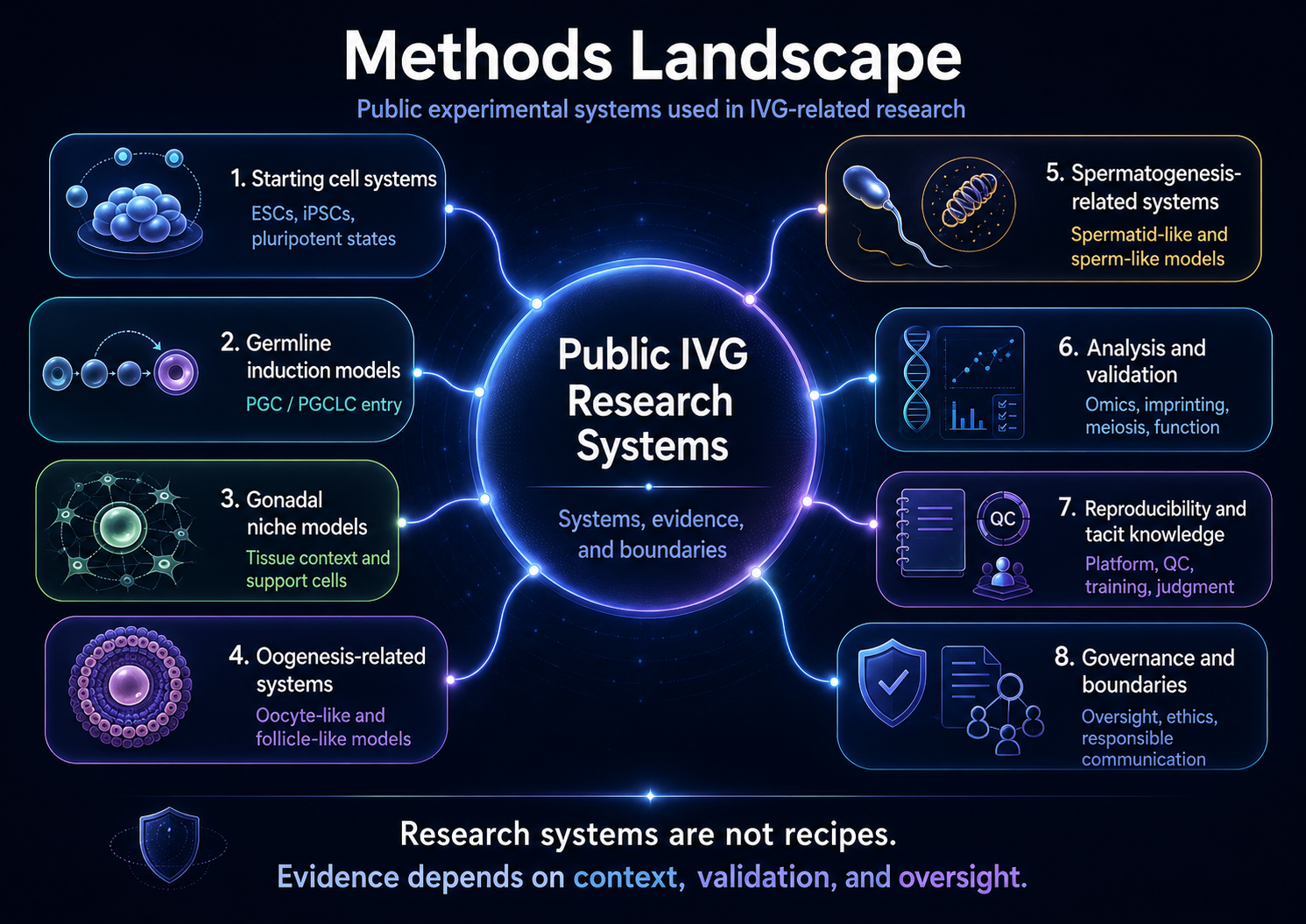
Public IVG-related research includes many interconnected systems: starting cell-state models, germline induction models, gonadal niche models, oogenesis-related systems, spermatogenesis-related systems, and multi-layer validation frameworks. These systems model different biological stages and provide different levels of evidence. [1–18]
Some systems model early cell-state transitions. Some model primordial germ cell-like states. Some introduce tissue context. Some reconstruct parts of oogenesis or spermatogenesis in animal models. Others evaluate whether gamete-like cells are biologically credible.
This page maps public research systems and evidence levels. It does not provide laboratory protocols, culture recipes, operational workflows, clinical guidance, patient recruitment, or reproductive services.
Core idea: Protocols describe what was done in specific studies. A methods landscape explains what each system can and cannot prove.
Key points
- IVG is a research landscape, not a single recipe. Different systems model different stages of germline and gamete development. [3–13]
- A system is not the same as a protocol. A public overview can explain research systems without becoming an executable laboratory manual.
- Similarity is not function. Marker expression, transcriptomic similarity, and epigenetic resemblance are useful, but they do not automatically prove gamete competence. [6–12]
- Mouse and human systems are not interchangeable. Mouse IVG provides strong functional evidence in a model organism, while human systems remain more limited and ethically constrained. [3–12]
- Validation matters as much as induction. A method is only as meaningful as the evidence used to evaluate its output.
- Protocols are not enough. Reproducibility depends on cell-state judgment, platform quality, quality control, training, and tacit knowledge.
- Open science and responsible boundaries can coexist. Method transparency supports review and accountability, but sensitive reproductive-lineage research requires oversight. [14–18]
1. What is a methods landscape?A methods landscape is not a step-by-step guide. It is a conceptual map of research systems.
It asks what kind of system is being used, which developmental stage it models, what the system can show, what it cannot prove, what evidence level it reaches, what validation methods are used, what tacit knowledge or platform context affects reproducibility, and what ethical or governance boundaries apply.
This distinction matters because IVG-related studies often use similar language for very different levels of evidence. A PGCLC model, an oocyte-like cell model, a testis organ culture system, and a mouse system that produces offspring are not equivalent forms of evidence. [3–12]
Core principle: A methods landscape helps readers understand research systems without turning them into unsupervised instructions.
2. System versus protocolA protocol, a method, a model system, an experimental platform, and a validation framework are different things.
A protocol describes what researchers did in a specific study. A method describes a broader technical approach. A model system represents a biological stage or process for research.
An experimental platform includes the technical environment that supports the model, such as cell culture systems, co-culture systems, organoid-like systems, animal models, sequencing platforms, imaging, and quality-control infrastructure.
A validation framework defines how researchers judge whether the result is biologically meaningful.
A tacit-knowledge layer includes the judgment, training, platform habits, and failure recognition that are difficult to capture in written methods.
An executable SOP is different from a public educational overview. This page provides the overview, not the SOP.
Public wording: This page maps systems, evidence, and limitations. It does not teach readers how to perform IVG.
3. Starting cell systemsMany IVG-related systems begin with embryonic stem cells or induced pluripotent stem cells, but the starting state matters.
Many IVG-related systems begin with embryonic stem cells or induced pluripotent stem cells. These cells are useful because they provide flexible starting states for modeling early developmental transitions. [1,2]
But the starting state matters. Pluripotency is not one uniform condition. Naïve, primed, formative, resetting, and intermediate states can differ in transcriptional networks, chromatin accessibility, X-chromosome state, epigenetic memory, and responsiveness to germline induction.
This is especially important when comparing mouse and human systems. A state that supports germline competence in one species may not map directly onto another species. [3,6,7,11,12]
What starting cell systems can show
They can help researchers evaluate starting-state quality, developmental plasticity, pluripotent-state differences, possible responsiveness to germline induction, and species-specific starting-state constraints.
What they cannot prove
Starting cell systems cannot by themselves prove germline commitment, meiosis, gamete maturation, fertilization-related function, embryo support, or developmental competence.
Core principle: A flexible starting state is necessary for many IVG models, but it is not proof of gamete competence.
4. Germline induction modelsGermline induction models attempt to move cells toward primordial germ cell-like states.
Germline induction models attempt to move cells toward primordial germ cell-like states. PGCLC models are central to IVG research because primordial germ cells are the embryonic ancestors of sperm and oocytes. [3,6,7]
Mouse PGCLC systems have been foundational for understanding how pluripotent cells can enter an early germline-like program. Human hPGCLC systems have also become important, but human germline specification is not a simple copy of mouse biology. [3,6,7]
In human systems, SOX17, PRDM1, TFAP2C, PRDM14, DAZL, DDX4, NANOS3, and related markers or regulators are often discussed as part of the germline-state framework. These markers help locate a cell along a developmental path. They do not by themselves prove that a mature gamete has been produced. [6,7,11,12]
What PGCLC models can show
PGCLC models can support claims about early germline-like identity, germline specification, partial exit from somatic programs, transcriptomic similarity to reference germ cells, early regulatory-network changes, some aspects of epigenetic resetting, and species differences in germline specification.
What PGCLC models cannot show alone
They cannot prove irreversible germline commitment, correct meiosis, sex-specific imprint establishment, oocyte cytoplasmic maturation, sperm chromatin remodeling, fertilization capacity, embryo support, or long-term developmental safety.
Core principle: PGCLC models can show entry into the germline path. They do not prove arrival at a competent gamete.
5. Gonadal niche and tissue-context modelsLater gametogenesis does not happen in isolation. Germ cells develop within gonadal tissue environments.
Later gametogenesis does not happen in isolation. Germ cells develop within gonadal tissue environments. [11–13]
This tissue context can include Sertoli cells, Leydig cells, granulosa cells, theca cells, stromal cells, endothelial contexts, extracellular matrix, paracrine signals, metabolism, spatial organization, and mechanical cues.
Gonadal niche models, co-culture systems, reconstituted ovary-like systems, testis-like systems, and organoid-like models try to capture parts of this developmental environment.
These systems are important because later oogenesis and spermatogenesis usually require more than a germ cell alone. However, an engineered niche is not automatically equivalent to a whole ovary or testis.
What tissue-context systems can show
They can show how tissue support influences germ-cell survival, sex-specific development, maturation, meiotic progression, later germline development, and niche-dependent cell-state transitions.
What they cannot prove alone
They cannot prove full organ equivalence, complete reproductive competence, long-term developmental safety, or human clinical readiness.
Core principle: Germ cells do not become gametes alone. They mature within a developmental ecology.
6. Oogenesis-related systemsOogenesis-related systems model the female germline path and require stronger evidence than oocyte-like resemblance.
Oogenesis-related systems model the female germline path, including oogonia-like states, follicle-like systems, oocyte growth, meiotic progression, and oocyte maturation. [4,5,8,12]
Mouse systems provide the strongest functional evidence in this area. Some mouse studies have shown that pluripotent stem cell-derived germline cells can be taken through extended oogenesis-related paths and produce oocytes capable of supporting offspring in animal models. [4,5]
Human systems are more limited. Public studies have generated oogonia-like states and advanced human germline-like cells toward later precursor stages, but they have not established fully validated, mature, functional human oocytes. [8,12]
Oocyte evaluation also requires more than nuclear status. Cytoplasmic maturation is essential. Mitochondrial organization, maternal RNA and protein stores, spindle quality, cortical granules, metabolic state, and embryo-support capacity all matter.
What oogenesis-related systems can show
They can model female germline progression, oogonia-like states, follicle-like organization, epigenetic resetting, meiotic entry, and aspects of oocyte maturation.
What they cannot prove without stronger evidence
They cannot prove full oocyte competence, embryo-support capacity, long-term safety, or human clinical readiness.
Core principle: An oocyte-like cell is not necessarily a competent oocyte.
7. Spermatogenesis-related systemsSpermatogenesis-related systems model the male germline path, but sperm-like morphology is not functional sperm.
Spermatogenesis-related systems model the male germline path, including spermatogonial stem cell systems, prospermatogonia-like states, spermatid-like states, sperm-like cells, testis organ culture, and testis organoid-like systems. [9,10]
Mouse systems again provide stronger functional evidence than human systems. Some animal systems have produced sperm or sperm-like outputs with high-level functional evidence. [9,10]
Human systems remain largely at the level of SSC-related models, prospermatogonia-like states, organoid-like systems, and partial spermatogenesis-related readouts.
Sperm evaluation cannot rely on appearance alone. A sperm-like shape or a haploid-like state is not enough. Functional sperm biology also involves meiosis, chromatin packaging, protamination, DNA integrity, acrosome-related function, motility, paternal genome delivery, and relevant sperm-borne molecular contributions.
What spermatogenesis-related systems can show
They can model male germline progression, testis-like support, meiosis-related states, chromatin remodeling, spermatid-like or sperm-like morphology, and selected functional features in animal models.
What they cannot prove without stronger evidence
They cannot prove fully functional sperm, normal paternal genome delivery, embryo support, long-term outcomes, or human clinical readiness.
Core principle: Sperm-like morphology is not the same as functional sperm.
8. Analysis and validation methodsValidation methods determine how strongly a result can be interpreted.
Validation categories can include marker expression, immunostaining, scRNA-seq, single-cell atlas mapping, trajectory analysis, ATAC-seq, DNA methylation profiling, imprinting analysis, allele-specific regulation, histone and chromatin-state profiling, karyotyping, copy-number analysis, aneuploidy detection, meiosis-related readouts, chromosome pairing and recombination categories, cytoplasmic maturation readouts, and embryo, placenta, offspring, and long-term animal-model outcomes where ethically appropriate.
Each method answers a different question.
Marker expression can show that a program has been activated. Single-cell mapping can show resemblance to a reference stage. Epigenomic profiling can show deeper regulatory similarity. Karyotyping and genome-stability analyses can reveal obvious risks. Meiotic readouts can indicate whether chromosome-level processes are being approached. Animal developmental outcomes can provide higher-level evidence, but they do not automatically translate to humans. [3–13]
Core principle: Validation is not a final stamp of success. It is a ladder of evidence.
9. Evidence ladder: from similarity to competenceEvidence in IVG-related research should be read as a ladder, not as a yes-or-no test.
- Marker expression — shows that selected germline or gamete-related programs may be activated. Does not prove identity or function.
- Transcriptomic similarity — shows resemblance to a reference developmental stage. Does not prove regulatory stability or functional competence.
- Chromatin and epigenetic similarity — shows deeper molecular alignment. Does not prove complete epigenetic safety or developmental competence.
- Regulatory-network stability — suggests that a cell has entered a more stable program. Does not prove later gametogenic progression.
- Germline commitment progression — shows movement beyond early germline-like identity. Does not prove meiosis or mature gamete formation.
- Meiotic progression — shows entry into chromosome-level gametogenic logic. Does not necessarily prove correct recombination, segregation, or haploid quality.
- Cytoplasmic maturation — supports gamete-specific functional preparation, especially in oocytes. Still requires developmental testing.
- Gamete-like function — supports partial functional potential. May still miss embryo, placental, and long-term risks.
- Embryo and placental development in animal models — tests higher developmental integration. Does not automatically translate to humans.
- Offspring and long-term outcomes in animal models — provides stronger animal-level evidence. Still requires caution in human interpretation.
- Intergenerational stability — the strongest animal-level evidence. Requires health, fertility, and cross-generation assessment.
Core principle: The earlier the evidence level, the more cautious the claim should be.
10. Mouse versus human systemsMouse IVG provides stronger functional evidence than human IVG, but mouse evidence is not human clinical readiness.
Mouse IVG research has demonstrated much stronger functional evidence than human IVG research. In mouse systems, researchers have reconstructed major parts of oogenesis and spermatogenesis and, in some studies, produced offspring in animal models. [3–5,9,10]
Human systems have made major progress in hPGCLC induction, oogonia-like states, prospermatogonia-like states, gonadal niche modeling, and germline epigenetic reprogramming. But public literature has not established an end-to-end system for producing fully validated, mature, functional human sperm or oocytes from pluripotent stem cells. [6–8,11,12]
Mouse-to-human translation is limited by differences in pluripotent states, embryo architecture, PGC specification, germline regulatory networks, imprinting, DNA methylation dynamics, X-chromosome regulation, gonadal niche development, meiosis, oocyte maturation, sperm chromatin remodeling, placental biology, and ethical and legal validation limits.
Public wording: Mouse systems show what may be biologically possible in a model organism. Human IVG requires human-specific evidence at each level of the trajectory.
11. Reproducibility and tacit knowledgeProtocols are important, but protocols are not enough.
Wet-lab biology depends on tacit knowledge: the trained judgment and practical experience that are difficult to capture in a written methods section.
In IVG-related research, tacit knowledge may include cell-state judgment, morphology reading, passaging skill, contamination control, batch-effect recognition, reagent and matrix variability, cell-line history, platform differences, timing judgment, failure-mode recognition, quality-control culture, lab notebook discipline, and ethical and biosafety infrastructure.
Tacit knowledge is not mysticism. It is practical judgment. It explains why a method may be publicly described but still difficult to reproduce without the right training, platform, and quality-control system.
Responsible public description: It is appropriate to explain why tacit knowledge matters. It is not appropriate for a public educational page to convert that knowledge into an unsupervised troubleshooting manual for sensitive reproductive-lineage experiments.
12. Open methods and responsible boundariesOpen methods matter, but sensitive reproductive-lineage research should not be framed as a public operational guide.
Open methods matter. Scientific methods should be transparent enough to support peer review, reproducibility, accountability, and correction.
But open science does not mean every sensitive method should be framed as a public operational guide. Reproductive-lineage research involving gametes, embryos, developmental potential, or possible heritable consequences requires institutional oversight, ethical review, trained personnel, quality-control systems, and clear governance. [14–18]
Protocols are not sacred secrets. They should not be treated as mystical property. But IVG-related reproductive methods are also not ordinary hobbyist instructions.
The responsible middle ground is to map systems, evidence levels, limitations, reproducibility barriers, and governance boundaries.
Core principle: Open methods and responsible boundaries can coexist.
13. Public learning resourcesPublic learning resources can help readers interpret research without becoming operating instructions.
This page can point readers toward public learning resources without presenting them as operating instructions.
IVG and germline biology seminars
These help readers understand research questions, developmental stages, evidence limits, and social implications.
Stem cell and reprogramming background
These help readers understand iPSC biology, pluripotency, cell-state transitions, and why starting-state quality matters. [1,2]
Single-cell and epigenomics background
These help readers understand why reference atlases, transcriptomics, methylation, chromatin accessibility, and imprinting analyses are important. [11,12]
Gonadal niche and organoid concepts
These help readers understand why later gametogenesis requires tissue context, support cells, spatial organization, and developmental ecology.
Ethics and governance resources
These help readers understand why IVG-related research requires oversight, public accountability, and careful communication. [14–18]
Boundary: Public learning resources should help readers interpret research. They should not be framed as “watch this and do the experiment.”
Risky wording and better public wording
| Risky wording | Better public wording | Why it is better |
|---|---|---|
| Beginner guide to doing IVG | Public map of IVG-related research systems | Avoids operational framing |
| Step-by-step protocol | Experimental system overview | Explains research design without enabling replication |
| Operation video | Public learning resource | Avoids implying tutorial use |
| How to make artificial gametes | How IVG-related systems model germline and gamete development | Avoids overclaiming |
| Make sperm and eggs in the lab | How researchers model stages of gametogenesis | Shifts from production to modeling |
| Human-ready method | Experimental human model system | Avoids clinical-readiness claims |
| Successful IVG | Evidence at a specific level in a specific model | Forces evidence-level precision |
| Safety proven | Safety questions remain under evaluation | Avoids premature claims |
| Reproducible recipe | Research system shaped by platform and quality control | Acknowledges tacit knowledge |
| Same-sex baby method | Animal research related to same-sex genetic reproduction barriers | Avoids misleading application language |
What remains unresolved
- Which human starting states most reliably support germline competence?
- How should human PGCLC progression be evaluated beyond marker expression?
- What counts as sufficient human germline epigenetic resetting?
- Which gonadal niche components are essential rather than optional?
- How can true meiosis be distinguished from incomplete or abnormal haploidization?
- Which oocyte cytoplasmic features best predict developmental competence?
- Which sperm chromatin and paternal-delivery features best predict functional competence?
- How should human systems be validated when animal-like functional endpoints are ethically unavailable?
- Which tacit knowledge areas most strongly affect reproducibility?
- How can open methods, public education, and reproductive governance be designed together?
Core references
- Takahashi K, Yamanaka S. Induction of pluripotent stem cells from mouse embryonic and adult fibroblast cultures by defined factors. 2006.
- Takahashi K et al. Induction of pluripotent stem cells from adult human fibroblasts by defined factors. 2007.
- Hayashi K et al. Reconstitution of the mouse germ cell specification pathway in culture by pluripotent stem cells. 2011.
- Hayashi K et al. Offspring from oocytes derived from in vitro primordial germ cell-like cells in mice. 2012.
- Hikabe O et al. Reconstitution in vitro of the entire cycle of the mouse female germ line. 2016.
- Irie N et al. SOX17 is a critical specifier of human primordial germ cell fate. 2015.
- Sasaki K et al. Robust in vitro induction of human germ cell fate from pluripotent stem cells. 2015.
- Yamashiro C et al. Generation of human oogonia from induced pluripotent stem cells in vitro. 2018.
- Sato T et al. In vitro production of functional sperm in cultured neonatal mouse testes. 2011.
- Ishikura Y et al. In vitro reconstitution of the whole male germ-cell development from mouse pluripotent stem cells. 2021.
- Garcia-Alonso L et al. Single-cell roadmap of human gonadal development. 2022.
- Murase Y et al. In vitro reconstitution of epigenetic reprogramming in the human germ line. 2024.
- Saitou M, Hayashi K. Mammalian in vitro gametogenesis. 2021.
- National Academies. In Vitro–Derived Human Gametes as a Reproductive Technology: Scientific, Ethical, and Regulatory Implications. 2023.
- ISSCR Guidelines for Stem Cell Research and Clinical Translation. 2021/2025.
- WHO. Human genome editing: a framework for governance. 2021.
- Nuffield Council on Bioethics. In vitro gametes: ethical and social considerations. 2025.
- HFEA. Regulatory considerations for in vitro gametes. 2025.
Research systems, evidence levels, and responsible boundaries.
This future video will explain why IVG is not one protocol, how different systems model different stages, why validation matters as much as induction, and why public education should map methods without becoming an unsupervised laboratory guide.