Mechanisms and Principles
The biological logic behind IVG and artificial gamete research
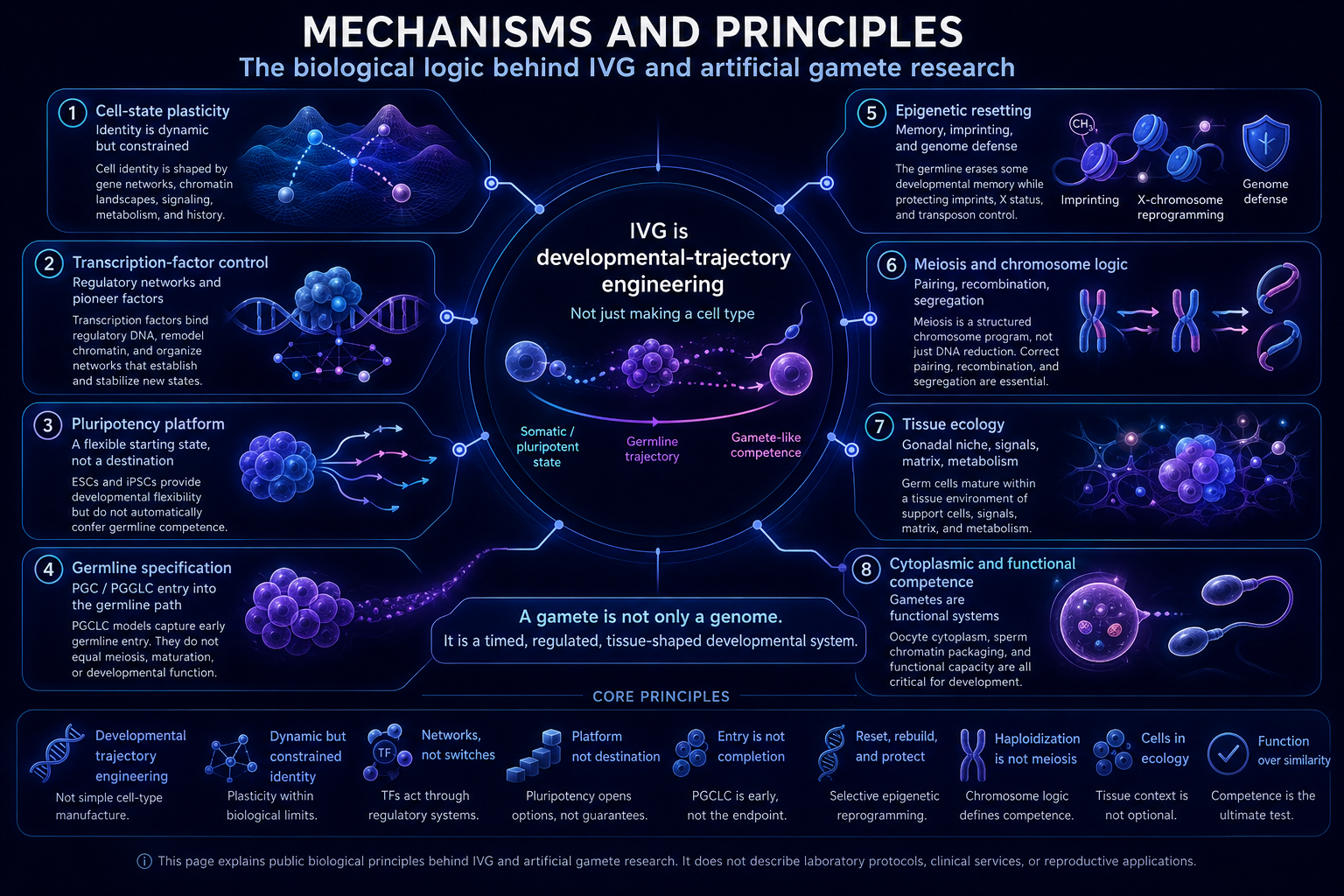
IVG is not the manufacture of a cell type. It is the reconstruction of a developmental logic.
A gamete is not only a genome. A gamete-like cell is not automatically a competent gamete. Natural gametogenesis depends on a long chain of biological events: cell-state transitions, transcriptional networks, chromatin accessibility, signaling environments, germline specification, epigenetic resetting, meiosis, tissue context, cytoplasmic maturation, and developmental function after fertilization.
This page explains the mechanisms and principles behind IVG and artificial gamete research. It does not describe laboratory protocols, culture recipes, clinical services, patient pathways, or private research methods.
The goal is to explain why IVG is biologically plausible, why it is difficult, and why similarity alone is not enough.
Key points
- IVG is developmental-trajectory engineering. It tries to reconstruct a path through cell-state changes, not simply create a cell that expresses gamete markers.
- Cell identity is dynamic but constrained. It is shaped by transcription factors, chromatin state, signaling, metabolism, and developmental history.
- Transcription factors are powerful, but not magic switches. They act through regulatory networks, enhancer activity, chromatin accessibility, and feedback loops.
- Pluripotency is a platform, not a destination. ESCs and iPSCs provide flexible starting points, but pluripotency does not automatically mean germline competence.
- PGCLC models are important but limited. They model early germline entry; they do not prove meiosis, gamete maturation, or developmental competence.
- Epigenetic resetting is selective reconstruction. The germline must erase some developmental memory while preserving genome stability, imprinting logic, transposon control, and sex-specific programs.
- Meiosis is not just haploidization. Correct chromosome pairing, recombination, segregation, and sex-chromosome behavior are central to gamete competence.
- Gametes develop in a tissue ecology. Gonadal somatic cells, extracellular matrix, paracrine signals, metabolism, and developmental timing all matter.
1. What does it mean to change a cell state?A cell type is often described by markers. But a cell state is deeper than a marker list.
It includes gene-expression programs, chromatin accessibility, enhancer activity, epigenetic memory, protein state, metabolism, spatial context, and developmental history.
This is why two cells can share several markers but still have different biological potential. One cell may only resemble a target state at the surface. Another may have entered a more stable regulatory program.
In IVG, this distinction is critical. A cell that expresses germline markers is not necessarily committed to the germline. A germline-like cell is not necessarily moving toward a competent gamete.
Core principle: A cell identity is not only what a cell expresses. It is also the regulatory state it occupies and the developmental options it still has.
2. Transcription factors and regulatory networksTranscription factors can change cell identity because they act at high-leverage points in gene-regulatory networks.
They can bind regulatory DNA, activate or silence gene programs, alter enhancer use, recruit chromatin regulators, help establish feedback loops, and stabilize new cell states.
Some transcription factors act as pioneer factors. They can access relatively closed chromatin and make regulatory regions available to other factors.
Some act as master regulators. They are not simple on/off switches, but high-level network nodes that help organize many downstream genes and reinforce lineage direction.
The discovery of iPSC reprogramming changed developmental biology because it showed that differentiated cell identity is stable but not irreversible. A mature somatic cell can sometimes be redirected toward a pluripotent state.
For IVG, this matters because gamete research often begins by changing cell state. But activating a few germline markers is not the same as rebuilding the regulatory architecture needed for gametogenesis.
Public wording: Transcription factors can help redirect cell states, but a stable developmental program requires network-level and chromatin-level reorganization.
3. Pluripotency as a developmental platformESCs and iPSCs are useful for IVG because they are more developmentally flexible than most somatic cells.
ESCs and iPSCs can serve as platforms for modeling early embryonic and germline-related transitions. But pluripotency is not one uniform state.
Important pluripotent-state concepts include naïve pluripotency, primed pluripotency, formative pluripotency, resetting states, and intermediate transition states.
These states are not interchangeable. Some may be more competent for germline induction than others.
In mouse systems, germline competence is linked to specific transitional states rather than pluripotency in general. Human systems are more complex. Human pluripotent states do not map perfectly onto mouse states, and human germline specification uses partly different regulatory logic.
This matters because the starting state shapes the whole downstream trajectory. A cell may be pluripotent but still carry epigenetic memory, X-chromosome abnormalities, culture-acquired changes, or lineage biases.
Core principle: Pluripotency opens a door, but it does not guarantee that the cell can follow the germline path.
4. Germline specification and PGCLC modelsPGCLC models attempt to reconstruct early germline specification in vitro.
Primordial germ cells are the embryonic ancestors of sperm and oocytes. PGCLC models are central to IVG because they provide an experimental entry point into germline development.
In mouse systems, PGCLC induction is linked to specific pluripotent transitions and germline-regulatory programs. In human systems, SOX17, PRDM1, and TFAP2C are central to early germline specification, while later commitment involves additional regulatory changes.
This means human PGCLC biology is not simply mouse PGCLC biology with different labels.
What PGCLC models can show
They can show that cells have entered an early germline-like transcriptional state and help researchers study germline specification, early regulatory networks, developmental timing, early epigenetic resetting, and species differences.
What PGCLC models cannot show alone
They do not prove irreversible germline commitment, correct meiosis, sex-specific imprinting, cytoplasmic maturation, fertilization capacity, embryo support, or long-term developmental competence.
Core principle: PGCLC induction can show entry into the germline path, but not arrival at a competent gamete.
5. Epigenetic resetting and developmental memoryThe germline must reset parts of its epigenetic history because gametes transmit developmental potential to the next generation.
This resetting includes DNA methylation erasure, imprint erasure, sex-specific imprint re-establishment, chromatin remodeling, X-chromosome reprogramming, transposon control, and small-RNA-mediated genome defense.
But epigenetic resetting is not simply wiping everything clean.
Some regions resist or delay demethylation. Some information must be protected. Imprints must be erased and rebuilt in the correct parent-of-origin pattern. Transposons must remain controlled during low-methylation windows. X-chromosome state must be coordinated with sex and developmental stage.
For artificial gamete-like cells, epigenetic similarity is therefore not enough. A cell may show global methylation loss while still failing at locus-specific imprinting, allele-specific regulation, histone state, 3D genome organization, X-chromosome regulation, or small-RNA-mediated genome defense.
Core principle: Epigenetic resetting is selective reconstruction, not simple erasure.
6. Meiosis, chromosomes, and gamete-specific logicGametes are not ordinary haploid cells. Meiosis is a structured chromosome program.
Meiosis is not merely the reduction of DNA content by half. Correct meiosis requires homologous chromosome pairing, synapsis, recombination, crossover formation, chromosome segregation, accurate haploidization, and appropriate sex-chromosome behavior.
This is one of the hardest parts of IVG. A cell may express meiotic markers or appear to reduce its DNA content, but that does not prove correct meiosis.
Aneuploidy, incomplete recombination, abnormal segregation, or inappropriate sex-chromosome behavior can make a cell genetically unsafe even if it looks gamete-like.
Core principle: Haploidization is not meiosis. A gamete is produced through chromosome logic, not only through marker expression or shape change.
7. Tissue context and developmental ecologyGerm cells do not become gametes alone. They mature within a tissue ecology.
In vivo, germ cells interact with Sertoli cells, Leydig cells, granulosa cells, theca cells, extracellular matrix, paracrine signals, cell-cell communication, metabolic support, mechanical environment, and developmental timing.
This is why tissue context is central to IVG.
Reconstructed ovary-like systems, testis-like systems, organoid-like models, and co-culture systems are not merely technical accessories. They are attempts to rebuild parts of the developmental environment that natural gametogenesis requires.
A single-cell model may be useful for early specification. Later gametogenesis usually requires a structured niche.
Core principle: Cells do not become gametes alone; they become gametes in a developmental ecology.
8. Cytoplasmic maturation and gamete competenceA gamete is a functional system, not just a genome.
For oocytes, nuclear maturity and cytoplasmic maturity are different. An oocyte-like cell may reach a meiotic stage but still lack the cytoplasmic machinery needed to support fertilization and early embryo development.
Oocyte competence may depend on mitochondrial organization, maternal RNA stores, maternal protein stores, spindle quality, cortical granules, metabolic support, and oocyte-to-embryo transition programs.
For sperm-like cells, morphology is also not enough. A sperm-like structure must be evaluated in relation to chromatin packaging, protamination, DNA integrity, acrosome function, motility, paternal genome delivery, and sperm-borne RNAs or other paternal contributions.
Core principle: “Oocyte-like” and “sperm-like” describe resemblance. They do not automatically mean competence.
9. Engineering versus natural developmentNatural development is a timed, spatial, historical, and self-regulating process.
Engineering can reconstruct parts of this process, but it does not automatically reproduce the whole causal system.
IVG is best understood as developmental-trajectory engineering. Researchers try to reconstruct selected causal modules: cell-state plasticity, germline specification, epigenetic resetting, meiosis, tissue support, cytoplasmic maturation, and functional output.
A model can be very valuable without being equivalent to nature. It can reveal mechanisms, test causal hypotheses, and map developmental barriers. But model value is not the same as reproductive readiness.
Four useful terms
Model: A system that reconstructs a stage or module for study.
Mimicry: A system that resembles a natural cell or tissue in selected readouts.
Mechanism: A system that reproduces a causal process that drives a biological state.
Competence: A system that performs the biological function required for later development.
Core principle: Endpoint similarity is not enough. The causal organization matters.
10. Evidence ladder: from similarity to competenceEvidence should be read as a ladder, not as a single yes-or-no test.
- Marker expression — shows partial identity. Does not prove function.
- Transcriptomic similarity — shows resemblance to a reference state. Does not necessarily prove regulatory stability.
- Chromatin and epigenetic similarity — shows deeper molecular alignment. Does not prove complete safety or competence.
- Regulatory-network stability — suggests the cell has entered a more stable program. Does not prove later developmental ability.
- Germline commitment progression — shows movement beyond early germline identity. Does not prove meiosis or maturation.
- Meiotic progression — shows entry into chromosome-level gametogenic logic. Does not necessarily prove correct segregation.
- Cytoplasmic maturation — supports gamete-specific function. Still requires developmental testing.
- Gamete function — supports direct fertilization-related potential. May still miss later risks.
- Embryo and placental development — tests higher developmental integration. Does not necessarily capture long-term outcomes.
- Offspring and long-term outcomes in animal models — provides stronger evidence. Does not automatically translate to humans.
- Intergenerational stability — the strongest animal-level evidence. Requires health, fertility, and cross-generation assessment.
11. Philosophical principles: identity, causality, and competenceConceptual clarity helps separate marker resemblance from biological mechanism and competence.
What is a cell identity?
It is not only a name or marker set. It is a regulated state with history, structure, and future potential.
What is the difference between mimicry and mechanism?
Mimicry means selected features look similar. Mechanism means the system reproduces a causal process that explains why the state exists.
What makes an artificial gamete biologically credible?
Not appearance alone. Not markers alone. Not one omics plot. Credibility requires a coherent chain from cell state to regulatory program, epigenetic resetting, meiosis, maturation, and developmental function.
Can engineering reproduce development without copying it?
Possibly. But bypassing one natural step creates new validation burdens. Engineering does not remove biology; it changes which biological assumptions must be tested.
When is a model no longer just a model?
Only when its evidence supports the function being claimed. A PGCLC model remains an early germline model. A gamete-like cell remains gamete-like unless it shows the competence expected of a gamete.
12. Human versus mouse mechanismsMouse IVG is foundational, but human IVG is not a direct extension of mouse IVG.
Mouse IVG is foundational because it has produced the strongest functional evidence. Mouse systems have shown that major parts of gametogenesis can be reconstructed under carefully engineered conditions.
Human IVG cannot be treated as a direct extension of mouse IVG because of differences in pluripotent states, PGC specification, imprinting, X-chromosome regulation, placental biology, meiosis, oocyte maturation, and ethical and legal limits on embryo research.
For this reason, mouse IVG should be read as proof that certain developmental modules can be engineered in mammals, not as evidence that human IVG is clinically ready.
Public wording: Mouse studies show what may be biologically possible in a model organism. Human IVG requires human-specific evidence at each level of the trajectory.
What remains unresolvedOpen questions remain across cell state, commitment, epigenetic resetting, tissue context, meiosis, cytoplasm, and public communication.
- Which human pluripotent or intermediate states most reliably support germline competence?
- What distinguishes early germline identity from irreversible germline commitment?
- Which regulatory networks must stabilize before later gametogenesis can proceed?
- What counts as correct human germline epigenetic resetting?
- Which tissue-context modules are necessary for human oogenesis and spermatogenesis models?
- How can true meiosis be distinguished from incomplete or abnormal haploidization?
- Which cytoplasmic features best predict oocyte competence?
- Which sperm chromatin and paternal-delivery features best predict sperm competence?
- How much natural developmental timing must be reconstructed?
- How should public communication explain mechanisms without implying protocols or clinical availability?
Core references
- Takahashi K, Yamanaka S. Induction of pluripotent stem cells from mouse embryonic and adult fibroblast cultures by defined factors. 2006.
- Takahashi K et al. Induction of pluripotent stem cells from adult human fibroblasts by defined factors. 2007.
- Trapnell C. Defining cell types and states with single-cell genomics. 2015.
- Zaret KS, Carroll JS. Pioneer transcription factors: establishing competence for gene expression. 2011.
- Iwafuchi-Doi M, Zaret KS. Pioneer transcription factors in cell reprogramming. 2014.
- Kinoshita M et al. Capture of mouse and human stem cells with features of formative pluripotency. 2021.
- Hayashi K et al. Reconstitution of the mouse germ cell specification pathway in culture by pluripotent stem cells. 2011.
- Hayashi K et al. Offspring from oocytes derived from in vitro primordial germ cell-like cells in mice. 2012.
- Hikabe O et al. Reconstitution in vitro of the entire cycle of the mouse female germ line. 2016.
- Irie N et al. SOX17 is a critical specifier of human primordial germ cell fate. 2015.
- Sasaki K et al. Robust in vitro induction of human germ cell fate from pluripotent stem cells. 2015.
- Yamashiro C et al. Generation of human oogonia from induced pluripotent stem cells in vitro. 2018.
- Hwang YS et al. Reconstitution of prospermatogonial specification in vitro from human induced pluripotent stem cells. 2020.
- Murase Y et al. In vitro reconstitution of epigenetic reprogramming in the human germ line. 2024.
- Saitou M. Mammalian in vitro gametogenesis. Science. 2021.
- National Academies. In Vitro–Derived Human Gametes as a Reproductive Technology: Scientific, Ethical, and Regulatory Implications. 2023.
- ISSCR. Guidelines for Stem Cell Research and Clinical Translation. 2021/2025.
- WHO. Human genome editing: a framework for governance. 2021.
Cell states, regulatory networks, developmental trajectories, and artificial gametes.