Technology Roadmap
This educational map summarizes public IVG-related research topics. It excludes private methods, unpublished analysis plans, internal scoring systems, and personal hypotheses.
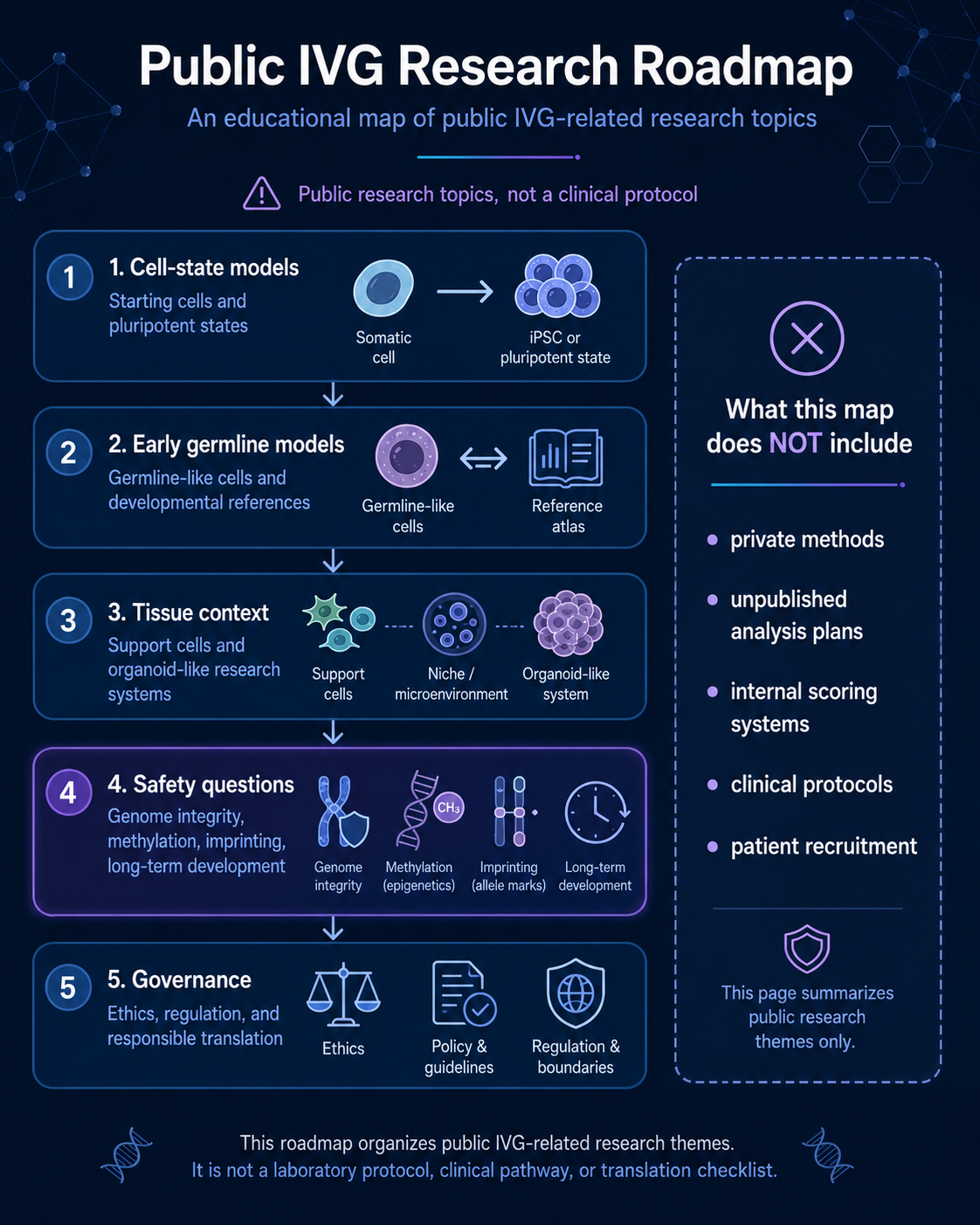
How to read this roadmap
This roadmap is an educational map of public IVG-related research. It organizes the field into five connected research areas: cell-state models, early germline models, tissue context, safety questions, and governance.
The roadmap should not be read as a clinical timeline or a step-by-step path toward reproductive use. A cell model, a developmental model, an engineering platform, a safety framework, and a clinical translation pathway are different things. Public IVG research has made important progress, especially in mouse systems and early human germline models, but different kinds of evidence support different kinds of conclusions.
The purpose of this page is to help readers understand what each research area has shown, what it has not shown, and what questions remain open.
Key points
- Mouse IVG research provides the strongest functional evidence so far, including stem-cell-derived germline cells, oocytes, sperm-related systems, and offspring in some mouse models. [3–9]
- Human IVG-related research is currently strongest at the level of hPGCLC, oogonia-like, pro-spermatogonia-like, and germline epigenetic reprogramming models. [10–15]
- “Germline-like” does not mean “functional gamete.” Marker expression, transcriptomic similarity, epigenetic similarity, meiotic progression, gamete maturation, and developmental competence are different evidence levels. [10–19]
- Tissue context is central. Germ cells develop through interaction with gonadal somatic cells, niche signals, extracellular matrix, metabolism, and developmental timing. [4–9], [18–19]
- Safety evaluation must include genome integrity, chromosomes, meiosis, imprinting, methylation, cytoplasmic maturation, embryo and placental development, and long-term outcomes. [15–19], [23–24]
- Governance is part of the roadmap, not an afterthought. IVG research raises questions about embryo research, consent, cell use, public communication, future children, and responsible translation. [20–24]
Cell-state modelsCell-state models focus on the starting point of IVG-related research. The central question is not simply whether a cell is pluripotent, but whether it is in a developmental state that is competent for germline induction.
IVG research often begins with embryonic stem cells, induced pluripotent stem cells, or reprogrammed somatic cells. However, pluripotency alone is not the same as germline competence. In mouse systems, germline induction usually depends on moving cells through a developmentally appropriate transition state before they become primordial germ cell-like cells. In human systems, the relationship between naïve, primed, formative, resetting, and intermediate pluripotent states is more complex. [1–3], [10–11]
This distinction matters because the starting cell state can shape the entire downstream trajectory. A cell may express pluripotency markers but still carry epigenetic memory from its tissue of origin, culture-acquired abnormalities, X-chromosome irregularities, imprinting instability, mitochondrial differences, or lineage biases that affect germline induction. For IVG, the starting cell is not a neutral background. It is part of the biological question. [1–3], [20–24]
Cell-state models can show that a cell population has entered a state associated with germline induction. They can also help compare which starting states are more likely to produce PGCLC-like cells. But they do not prove that the cells will complete meiosis, establish correct imprints, mature into functional gametes, or support healthy development. [10–15]
What this module has shown
Mouse studies have shown that germline competence is tied to specific pluripotent transition states rather than to pluripotency in general. Human studies have shown that hPGCLC induction can be improved by using particular intermediate states, but human pluripotent-state definitions and quality-control standards remain less settled. [3], [10–11]
What remains unresolved
The main open questions are which human cell states are most reliably competent for germline induction, how epigenetic memory affects IVG differentiation, and what level of genomic, epigenomic, X-chromosome, and mitochondrial quality control should be required before reprogrammed cells are used as IVG starting material. [10–15], [20–24]
Early germline modelsEarly germline models ask whether in-vitro-derived cells resemble early germline development. They are essential research tools, but they are not the same as mature gametes.
Early germline models include PGCs, PGCLCs, hPGCLCs, oogonia-like cells, and pro-spermatogonia-like cells. These models allow researchers to study germline specification, early germ-cell identity, sex-specific divergence, and epigenetic reprogramming in systems that can be compared with fetal germ-cell reference datasets. [10–19]
Human PGCLC research has established important principles. The SOX17-PRDM1-TFAP2C axis helps define human early germline specification, and hPGCLC induction is now a major platform for studying early human germline development. Later-stage models, including oogonia-like and pro-spermatogonia-like states, have pushed the field beyond the earliest PGCLC stage. Recent work has also reconstructed important parts of human germline epigenetic reprogramming in vitro. [10–15]
However, identity and competence must be separated. A germline-like cell may resemble early germ cells in marker expression, transcriptional state, or epigenetic features. A later germline-like cell may resemble oogonia or prospermatogonia. But a developmentally competent gamete requires much more: correct meiosis, haploidization, imprint erasure and re-establishment where appropriate, cytoplasmic maturation, fertilization capacity, and developmental support after fertilization. [10–19]
The choice of reference dataset is also important. Human germline-like cells should be compared with stage-matched, sex-matched, and tissue-context-matched fetal germ-cell references where possible. Comparison with adult gonadal cells or mature gametes can be misleading if the model is actually closer to an early fetal stage. [16–19]
What this module has shown
Human systems can produce hPGCLC and later germline-like states, and some models reproduce major features of human germline epigenetic reprogramming. These are important advances for developmental biology and disease modeling. [10–15]
What remains unresolved
The unresolved question is whether these cells can progress through the later stages that define functional gametogenesis. Current human models do not prove mature, developmentally competent human gametes. The gap between early germline identity and functional gamete competence remains large. [10–19]
Tissue contextGerm-cell development does not occur in isolation. Tissue context is a major determinant of germline progression, meiosis, maturation, and developmental quality.
In vivo, germ cells develop within gonadal tissues. They interact with Sertoli cells, Leydig cells, granulosa cells, theca cells, stromal cells, extracellular matrix, paracrine signals, metabolic support systems, and changing developmental environments. These interactions are not optional background conditions. They help define whether germ cells remain early, enter sex-specific pathways, begin meiosis, mature, or fail. [18–19]
Mouse IVG has advanced partly because tissue context can be reconstructed more effectively in mouse systems. Reconstituted ovary systems have supported PGCLC-derived oocyte development and, in some models, offspring. Testis organ culture and other reconstructed male germline systems have supported spermatogenesis-related development and functional outputs in mice. These mouse studies show that tissue architecture and somatic support are central parts of IVG, not merely technical accessories. [4–9]
Human tissue-context models are less complete. Some studies use xenogeneic reconstituted ovary or testis systems, hindgut organoids, peri-implantation-like engineered environments, or other support models to improve human germline progression. These systems are valuable for mechanism discovery, but they do not yet show that a fully human, reproducible, ethically acceptable, and functionally mature tissue-context platform has been achieved. [12–15], [18–19]
Tissue-context models should be evaluated by more than morphology. A follicle-like or seminiferous-tubule-like structure is not enough. Validation should include cell composition, spatial organization, transcriptomic and epigenomic stage matching, germ-cell–somatic-cell signaling, meiosis, mitochondrial and cytoplasmic maturation, and functional output in species where such testing is permitted. [4–9], [18–19]
What this module has shown
Mouse systems demonstrate that reconstructed ovarian and testicular contexts can support major parts of gametogenesis. Human systems show that tissue-like support can improve germline progression and provide more realistic developmental models. [4–9], [12–15]
What remains unresolved
A major unresolved challenge is building human-relevant tissue platforms that are reproducible, ethically acceptable, species-appropriate, and strong enough to support later germline development rather than only early identity. [12–15], [20–24]
Safety questionsSafety questions are central to IVG because gametes transmit genetic and epigenetic information to the next generation. A gamete-like identity is not enough.
IVG safety is not a final checklist added after cells appear to differentiate. It is a framework that spans the entire process: starting-cell quality, genome integrity, chromosomal stability, copy-number variation, structural variation, mitochondrial function, DNA methylation, imprinting, allele-specific methylation, meiosis, recombination, cytoplasmic maturation, embryo development, placental development, postnatal health, and possible intergenerational effects. [15–19], [20–24]
Marker expression is not sufficient. Germline markers can support the claim that a cell has entered a germline-like state, but they do not prove correct imprint erasure, meiotic recombination, haploidization, cytoplasmic maturation, or developmental competence. [10–15]
Transcriptomic similarity is also not enough. A cell may map near fetal germ cells in single-cell analysis, but this does not prove that it has reproduced the correct developmental timing, chromatin state, imprinting program, or functional trajectory. [15–19]
Epigenetic safety is especially important. Global DNA methylation changes can be informative, but imprinting requires locus-specific and allele-specific analysis. IVG-related cells may need to erase, maintain, or re-establish methylation in ways that are stage-specific and sex-specific. A small panel of classic imprinted loci may be useful, but it cannot substitute for broader epigenomic evaluation. [15–19]
Meiosis and cytoplasmic maturation are also major safety barriers. A cell that enters meiosis has not necessarily completed homologous chromosome pairing, recombination, segregation, and haploidization correctly. An oocyte-like cell may have nuclear maturation without adequate mitochondrial function, maternal-factor storage, or cytoplasmic competence. [4–9], [15–19]
Early embryo development is not a sufficient endpoint. Cleavage or blastocyst-like development can exclude only some severe failures. It does not prove implantation, placental development, fetal growth, postnatal health, fertility, or intergenerational stability. [20–24]
Evidence levels in IVG research
- Marker expression: shows partial identity, not function.
- Transcriptomic similarity: shows resemblance to a reference state, not developmental competence.
- Epigenetic similarity: shows progress in reprogramming, not complete imprinting fidelity.
- Meiotic progression: shows entry into meiosis, not necessarily correct chromosome segregation.
- Gamete maturation: shows a more advanced gamete-like state, not necessarily healthy developmental output.
- Developmental competence: in permitted animal models, this includes fertilization, embryo development, birth, health, and ideally fertility and long-term follow-up.
What this module has shown
Public research has clarified that IVG safety must be multi-layered. Identity, epigenetic state, meiosis, maturation, development, and long-term outcomes are different evidence levels. [10–24]
What remains unresolved
The major unresolved problem is identifying which assays truly predict developmental competence and long-term safety, rather than merely describing similarity to a known cell type. [20–24]
GovernanceGovernance is not an appendix to IVG research. It is part of the roadmap because IVG involves germ cells, embryos, future children, consent, public communication, and possible heritable effects.
IVG research sits at the intersection of stem-cell biology, reproductive science, embryo research, genome and epigenome safety, and public ethics. Governance is therefore not only about future clinical use. It is also about how research is conducted, how materials are obtained, how claims are communicated, and how boundaries are maintained between research models and reproductive services. [20–24]
Consent is one major issue. If ordinary somatic cells could be used to derive gamete-like cells, then a donated cell sample may have reproductive significance. Broad consent for general research use should not automatically be treated as consent for reproductive use. Clearer rules are needed for cell donation, iPSC line creation, embryo-related research, privacy, future use, and commercialization. [20–24]
Public communication is another governance issue. IVG is vulnerable to overstatement because the idea of lab-derived gametes has strong social and emotional meaning. Scientific communication should distinguish mouse evidence from human evidence, early models from mature gametes, and research tools from reproductive services. [20–24]
Governance also includes embryo research oversight, stem-cell research review, rules for heritable genome editing where relevant, clinical translation thresholds, long-term monitoring, and protection against medical tourism or gray-market claims. A public IVG roadmap should therefore describe the evidence landscape without turning it into a clinical timeline. [20–24]
What this module has shown
International guidance from stem-cell, genome-editing, and reproductive-technology discussions treats IVG as a field requiring specialized oversight, careful consent, clear evidence thresholds, and responsible public communication. [20–24]
What remains unresolved
The field still needs clearer frameworks for consent, human germline model oversight, preclinical evidence thresholds, long-term safety requirements, and public communication standards that avoid both false hope and dismissive framing. [20–24]
What this roadmap is and is notThis page is a public research map. It is not a protocol, clinical pathway, or translation checklist.
A research roadmap organizes public evidence. It shows which areas of research exist, what model systems are used, what kinds of evidence have been produced, and what questions remain unanswered.
A developmental biology model recreates a particular stage or transition, such as PGCLC induction or fetal germ-cell-like development. An engineering platform reconstructs a tissue or microenvironment, such as an ovary-like, testis-like, organoid-like, or co-culture system. A safety framework evaluates genome integrity, methylation, imprinting, meiosis, maturation, embryo development, placental development, and long-term outcomes.
A clinical translation pathway is different. It would require regulatory review, robust preclinical evidence, long-term monitoring, clinical justification, and patient-facing oversight. Public IVG research should not be read as evidence that mature human gametes are available or that reproductive use is ready. [20–24]
Mouse-to-human translation gapsMouse IVG evidence is essential, but it cannot be read as human IVG readiness.
Mouse systems provide the most complete functional evidence in IVG. Mouse stem-cell-derived germline cells have been used to produce oocytes, sperm-related systems, and offspring in some models. These studies are crucial because they show that large parts of gametogenesis can be reconstructed under the right conditions. [3–9]
Human systems are different. Human pluripotent states do not map perfectly onto mouse pluripotent states. Human germline specification uses partly different regulatory logic. Human imprinting and placental biology differ from mouse systems. Human oocyte maturation and meiosis have their own timing and quality-control challenges. Human embryo research also faces ethical and legal limits that restrict functional validation. [10–24]
For this reason, mouse IVG is not a human clinical roadmap. It is an essential experimental foundation, but translation requires human-specific evidence at each level: cell state, germline identity, epigenetic reprogramming, tissue context, safety, and governance. [10–24]
Open research questionsThese questions separate early identity, engineering platforms, safety frameworks, and possible future translation thresholds.
- Which human pluripotent or intermediate states most reliably support hPGCLC induction while minimizing genomic and epigenomic abnormalities?
- How much does epigenetic memory from the original somatic cell influence IVG-related differentiation?
- Where does hPGCLC similarity to fetal PGCs stop being informative for later germline competence?
- Can human in-vitro germline models reproduce the timing, extent, and locus-specificity of germline epigenetic reprogramming?
- Which gonadal somatic cell populations are required to support human germline progression, meiosis, and maturation?
- Can organoid-like or reconstructed niche systems support later functional maturation rather than only early identity?
- Which assays predict developmental competence rather than merely classify cell identity?
- How should imprinting fidelity be evaluated genome-wide and allele-specifically?
- What long-term and intergenerational evidence would be required in animal systems before human relevance can be responsibly discussed?
- How should public communication separate research models, engineering platforms, safety frameworks, and clinical translation pathways?
Core references
- Takahashi K, Yamanaka S. Induction of pluripotent stem cells from mouse embryonic and adult fibroblast cultures by defined factors. 2006.
- Takahashi K et al. Induction of pluripotent stem cells from adult human fibroblasts by defined factors. 2007.
- Hayashi K et al. Reconstitution of the mouse germ cell specification pathway in culture by pluripotent stem cells. 2011.
- Hayashi K et al. Offspring from oocytes derived from in vitro primordial germ cell-like cells in mice. 2012.
- Hikabe O et al. Reconstitution in vitro of the entire cycle of the mouse female germ line. 2016.
- Sato T et al. In vitro production of functional sperm in cultured neonatal mouse testes. 2011.
- Ishikura Y et al. In vitro derivation and propagation of spermatogonial stem cell activity from mouse pluripotent stem cells. 2016.
- Zhou Q et al. Complete meiosis from embryonic stem cell-derived germ cells in vitro. 2016.
- Yoshino T et al. Generation of ovarian follicles from mouse pluripotent stem cells. 2021.
- Irie N et al. SOX17 is a critical specifier of human primordial germ cell fate. 2015.
- Sasaki K et al. Robust in vitro induction of human germ cell fate from pluripotent stem cells. 2015.
- Yamashiro C et al. Generation of human oogonia from induced pluripotent stem cells in vitro. 2018.
- Hwang YS et al. Reconstitution of prospermatogonial specification in vitro from human induced pluripotent stem cells. 2020.
- Murase Y et al. Long-term expansion with germline potential of human primordial germ cell-like cells. 2020.
- Murase Y et al. In vitro reconstitution of epigenetic reprogramming in the human germ line. 2024.
- Guo F et al. The transcriptome and DNA methylome landscapes of human primordial germ cells. 2015.
- Gkountela S et al. DNA demethylation dynamics in the human prenatal germline. 2015.
- Li L et al. Single-cell RNA-seq analysis maps development of human germline cells and gonadal niche interactions. 2017.
- Garcia-Alonso L et al. Single-cell roadmap of human gonadal development. 2022.
- ISSCR. Guidelines for Stem Cell Research and Clinical Translation. 2021/2025.
- WHO. Human genome editing: a framework for governance. 2021.
- WHO. Human genome editing: recommendations. 2021.
- National Academies. In Vitro–Derived Human Gametes as a Reproductive Technology: Scientific, Ethical, and Regulatory Implications. 2023.
- National Academy of Medicine, National Academy of Sciences, and the Royal Society. Heritable Human Genome Editing. 2020.